
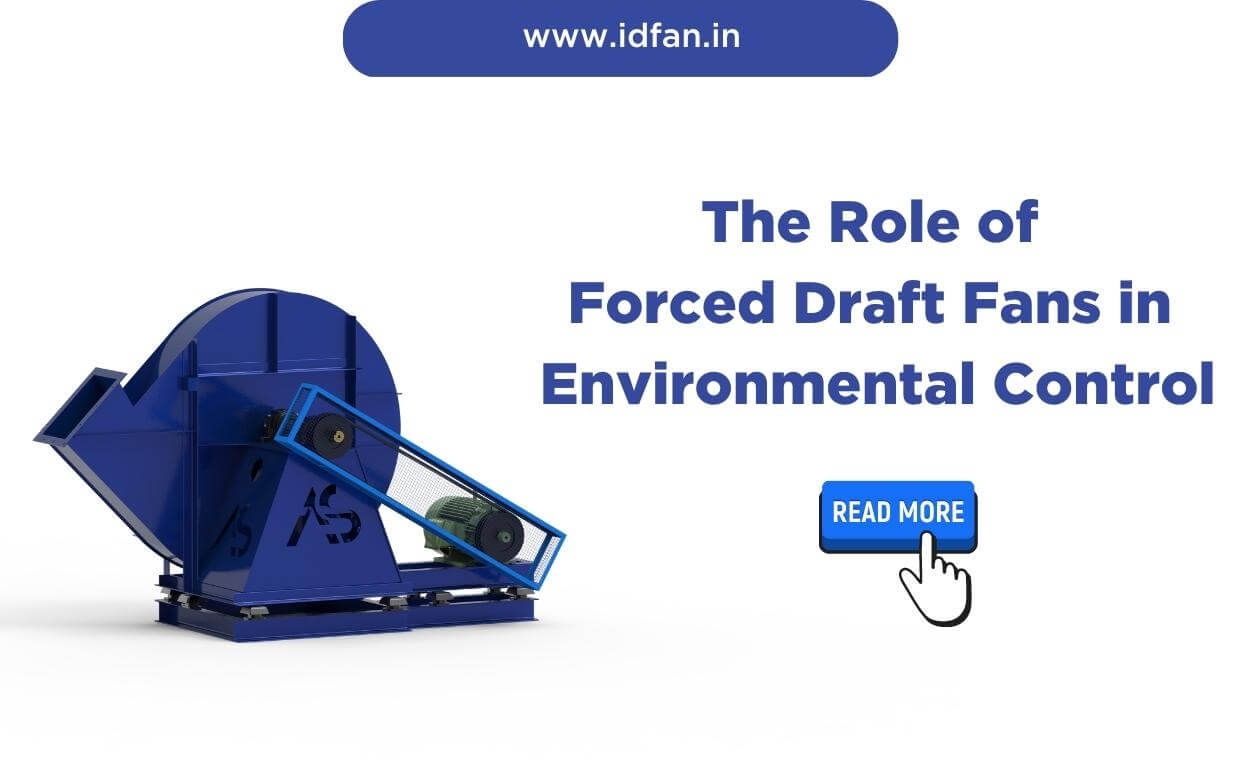
Forced Draft Fans in Environmental Control
Forced draft fans in environmental control do not remove pollutants by themselves. Their real job is to deliver controlled air into boilers, furnaces, dryers, hot air generators, combustion chambers, ventilation systems, and selected process-air systems so the complete environmental control train can work properly.
In industrial plants, this matters because air movement affects combustion quality, heat balance, duct pressure, operator comfort, dust capture, and the performance of downstream equipment such as scrubbers, cyclones, bag filters, and ID fans.
A forced draft fan, also called an FD fan or forced draft blower, pushes air into a system. An ID fan pulls flue gas or process exhaust out of the system. If you want a detailed comparison, read our guide on forced draft fans vs induced draft fans.
What a Forced Draft Fan Actually Does in Environmental Control
An FD fan creates positive air pressure and supplies the required air volume to the process. In a boiler or furnace, this usually means combustion air. In a dryer or hot air system, it may mean air for heating, scavenging, cooling, or controlled ventilation.
Environmental control depends on this airflow because most industrial emission-control systems are not just one machine. They are a connected system of air supply, combustion, exhaust movement, dust collection, gas cleaning, ducting, dampers, and stack discharge.
A forced draft fan supports this system by helping maintain:
- Controlled combustion air supply
- Stable air-to-fuel ratio
- Required air volume through heaters or burners
- Positive pressure where the process needs pushed air
- Better air distribution inside the equipment
- Make-up air for ventilation or exhaust systems
- Consistent airflow before exhaust treatment starts
At the same time, the FD fan should not be confused with the ID fan. In most pollution-control layouts, the ID fan handles dirty or hot exhaust movement through equipment such as scrubbers, cyclones, ESPs, or bag filters. The FD fan usually handles cleaner incoming air or preheated air on the supply side.
For pollution-control-side airflow, you can also review our article on ID fans in the air pollution control industry.
Why FD Fans Matter for Cleaner Combustion
In boilers, furnaces, ovens, incinerators, hot air generators, and many thermal systems, poor air supply creates unstable operation. If the air volume is too low, fuel may not burn properly. If the air volume is too high, heat losses can increase and the system may become inefficient.
A properly selected FD fan helps the plant maintain the right combustion-air supply for the actual duty condition.
When I review an FD fan requirement, I do not start with motor HP alone. I first look at the process, airflow, static pressure, air temperature, altitude, duct length, damper position, burner requirement, operating hours, and whether the downstream exhaust side has enough ID fan capacity.
For boiler-specific airflow, read our dedicated page on forced draft fans in boiler systems.
FD Fan vs ID Fan in Environmental Control
| Point | Forced Draft Fan | Induced Draft Fan |
|---|---|---|
| Basic function | Pushes air into the system | Pulls flue gas or process exhaust out |
| Pressure role | Positive draft | Negative draft |
| Typical air/gas handled | Fresh air, combustion air, preheated air, process air | Hot flue gas, fumes, dust-laden gas, scrubber exhaust |
| Common position | Before burner, furnace, boiler, heater, dryer, or air inlet | After boiler, furnace, bag filter, scrubber, cyclone, or dust collector |
| Environmental role | Supports controlled combustion, make-up air, heat balance, and process airflow | Supports exhaust removal and movement through pollution-control devices |
| Selection concern | Air volume, static pressure, density, temperature, duct losses, burner requirement | Gas temperature, dust load, corrosion risk, moisture, fan erosion, system resistance |
In many plants, environmental problems happen because this difference is not respected. A plant may increase FD fan capacity without checking ID fan draft. Or it may replace an ID fan without checking combustion-air balance. Both sides must be reviewed as one system.
Where Forced Draft Fans Are Used in Environmental Control
Boilers and Steam Generation
FD fans supply combustion air to boiler furnaces. Their performance affects flame stability, fuel burning, excess air control, and overall draft balance. The FD fan must match burner demand, fuel type, duct resistance, air preheater losses, damper losses, and operating load variation.
In a boiler system, FD fan selection should not be isolated from ID fan capacity. If the FD fan pushes more air than the ID fan and stack can handle, furnace pressure and combustion stability may become difficult to control.
Furnaces and High-Temperature Processes
In furnaces, kilns, ovens, and hot air generators, FD fans help supply controlled air for combustion or process heating. The key issue is not only airflow quantity. The air must reach the right zone, at the right pressure, with stable control.
For furnace-side systems, fan selection should consider air temperature, burner arrangement, duct leakage, damper control, refractory condition, and heat-up cycle.
Scrubber and Wet Pollution-Control Systems
A scrubber removes pollutants through gas-liquid contact, but the fan system decides how reliably gas moves through the scrubber. In many arrangements, the ID fan pulls exhaust through the scrubber, while the FD fan may supply combustion air, make-up air, or process air upstream.
If the FD fan and ID fan are not balanced, the scrubber can face unstable gas loading. That affects pressure drop, mist carryover risk, liquid distribution, and overall operating stability.
For equipment-side support, AS Engineers’ ecosystem includes scrubber manufacturers and broader pollution control equipment resources.
Bag Filters and Dust Collection
In bag filter systems, airflow balance is critical. A bag filter needs the right gas velocity, pressure drop, cleaning cycle, and dust-loading condition. The FD fan may not always be directly connected to the bag filter, but it can influence upstream combustion or process-air volume, which then affects exhaust volume on the pollution-control side.
When dust load increases or filter bags start choking, the system resistance rises. If the fan selection did not include enough pressure margin, airflow may drop and capture performance may become unstable.
You can also refer to AS Engineers’ bag filter manufacturers page for equipment context.
Cyclone Separators
Cyclones are commonly used before bag filters, scrubbers, or other pollution-control equipment to remove heavier dust particles. The fan system must overcome cyclone pressure drop and maintain the required gas velocity. If the airflow is too low, separation can become weak. If airflow is excessive, pressure loss and energy consumption can increase.
For related equipment context, see AS Engineers’ page on cyclone separator manufacturer.
Dryers and Process-Air Systems
In dryers, hot air systems, and thermal processing equipment, FD fans may supply fresh air, heated air, or scavenging air. The goal is to maintain stable drying, prevent condensation in selected systems, and support controlled vapour movement.
In AS Engineers’ paddle dryer process layout, FD blower support can be used in the scavenging system, while the pollution-control train may include an ID fan, cyclone, scrubber, or bag filter depending on application. This is a good example of why FD and ID fan duties must be separated clearly.
Industrial Ventilation and Make-Up Air
Environmental control is not limited to stack emissions. Many plants also need make-up air, heat removal, fume dilution, or fresh-air supply for process zones. FD fans can support controlled ventilation where air must be pushed into a space, duct, chamber, or equipment zone.
However, for worker exposure, statutory compliance, or hazardous fumes, fan selection must be reviewed with proper EHS and engineering inputs. A fan alone is not a compliance solution.
Selection Factors for FD Fans in Environmental Control
AS Engineers considers practical duty inputs such as application, air volume, pressure, density, temperature, dust load, humidity, site condition, altitude, MOC, impeller design, and motor mounting arrangement when reviewing industrial blower requirements.
For a forced draft fan in environmental control, these inputs are especially important:
| Selection Input | Why It Matters |
|---|---|
| Airflow requirement | Decides how much air the fan must deliver to the system |
| Static pressure | Decides whether the fan can overcome duct, damper, heater, filter, and equipment resistance |
| Air temperature | Affects density, fan load, motor selection, and material suitability |
| Dust or moisture | Impacts impeller wear, corrosion risk, maintenance frequency, and MOC |
| Fuel or process type | Changes combustion-air demand and exhaust volume |
| Duct layout | Poor duct design can increase system effect and reduce real airflow |
| Altitude and ambient condition | Changes air density and fan performance |
| Control method | Damper, VFD, or system automation affects operating stability |
| MOC and impeller type | Must suit temperature, corrosion, abrasion, and duty cycle |
| Maintenance access | Important for bearing, belt, coupling, impeller, and vibration checks |
For deeper selection guidance, read our guide on expert tips for choosing the right forced draft fan.
Common Mistakes Plants Make With FD Fans
Selecting by Motor HP Instead of Duty Point
Motor HP is not the starting point. It is an output of selection. The correct starting point is airflow, static pressure, air density, temperature, duty cycle, and system resistance.
A fan with high motor HP can still fail if the impeller, RPM, pressure curve, or duct condition does not match the application.
Ignoring Duct Losses and Dampers
Many FD fan problems come from the system, not the fan. Long ducting, sharp bends, undersized dampers, poor inlet condition, flexible connections, filters, air preheaters, and leakage can change the real pressure requirement.
Not Matching FD Fan and ID Fan Capacity
In combustion and pollution-control systems, FD and ID fans must work together. If one side is changed without checking the other, the plant may face unstable furnace pressure, poor draft control, excess power consumption, or weak exhaust movement.
Treating Pollution Control as Only a Fan Problem
A fan moves air or gas. It does not replace a scrubber, cyclone, bag filter, ESP, or proper duct design. Environmental control needs the full system to be designed and maintained together.
Forgetting Maintenance Access
FD fans still need inspection, cleaning, alignment, bearing checks, vibration monitoring, and motor condition review. Environmental-control equipment often runs for long hours, so small fan issues can become plant-wide process issues.
For maintenance-side guidance, read 5 tips for maintaining your industrial duty fan.
How FD Fan Problems Show Up in Environmental Systems
| Symptom | Possible Cause | What to Check First |
|---|---|---|
| Poor combustion or flame instability | Low or unstable air supply | FD fan curve, damper position, burner demand, duct leakage |
| High power consumption | Excess pressure drop or poor control | Duct layout, filter choking, damper throttling, VFD settings |
| Low process airflow | System resistance higher than design | Filters, air preheater, duct blockage, wrong fan duty point |
| Vibration or noise | Impeller imbalance, bearing issue, misalignment | Foundation, alignment, bearing, impeller buildup |
| Dust leakage near equipment | Draft imbalance or poor exhaust pull | FD-ID fan balance, leakage points, ID fan capacity |
| Scrubber instability | Variable gas loading or pressure drop | Fan control, duct pressure, liquid flow, mist eliminator condition |
| Bag filter pressure rise | Filter choking or cleaning issue | Bag condition, DP trend, cleaning cycle, airflow rate |
Recommended RFQ Data for Forced Draft Fans
To select an FD fan properly, share complete duty data. Incomplete RFQ data usually leads to oversizing, undersizing, or repeated revisions.
Send these details before final selection:
- Application name, such as boiler, furnace, dryer, scrubber support, ventilation, or hot air system
- Required airflow in CFM, m³/hr, or actual m³/hr
- Static pressure requirement in mmWG, Pa, or equivalent
- Air temperature at fan inlet
- Ambient temperature and site altitude
- Fuel type or process description, if used for combustion
- Dust, moisture, fumes, or corrosive elements, if present
- Duct layout, inlet condition, outlet condition, bends, dampers, and filters
- Required MOC, if already specified by the plant
- Direct drive, belt drive, or coupling preference
- VFD or damper control requirement
- Operating hours per day
- Space limitation and mounting arrangement
- Required inspection, balancing, or documentation scope
If you are comparing multiple fan options, also review our page on ID fan design, selection criteria, and operation because many selection principles apply across industrial fan systems.
How AS Engineers Reviews Environmental-Control Fan Requirements
At AS Engineers, the fan is reviewed as part of the process-air or exhaust-air system, not as an isolated rotating machine. For environmental-control applications, we look at the actual operating condition, pressure losses, temperature, dust load, humidity, corrosion risk, impeller suitability, motor arrangement, and maintenance expectations.
AS Engineers’ broader equipment ecosystem includes industrial centrifugal blowers, pollution-control equipment, bag filters, scrubbers, cyclones, and application-specific air movement support. For high-pressure blower context, you can also read high-pressure blowers in the air pollution control industry.
The right FD fan should help the plant maintain stable air supply, reduce avoidable airflow problems, and support the environmental-control system without creating unnecessary energy load or maintenance complexity.
FAQs
What is the role of a forced draft fan in environmental control?
A forced draft fan supplies controlled air into a boiler, furnace, dryer, hot air system, ventilation system, or process-air arrangement. In environmental control, it supports stable combustion, make-up air, heat balance, and airflow control. It does not remove pollutants by itself.
Is an FD fan used before or after a pollution-control system?
An FD fan is usually on the air-supply side, before combustion or process equipment. An ID fan is more commonly used after the process to pull flue gas or contaminated exhaust through pollution-control equipment such as scrubbers, cyclones, or bag filters.
Can a forced draft fan reduce emissions?
An FD fan can support cleaner and more stable operation by supplying the required combustion or process air. However, emission reduction depends on the full system, including combustion control, fuel quality, process condition, pollution-control equipment, operation, and maintenance. A fan alone should not be treated as an emission-control guarantee.
Which fan is better for pollution control, FD fan or ID fan?
Both can be required, but their duties are different. FD fans push clean or preheated air into the system. ID fans pull exhaust, fumes, or flue gas through pollution-control devices. In many industrial systems, proper environmental control depends on correct FD-ID fan balance.
What data is needed to select an FD fan for environmental control?
The main RFQ data includes airflow, static pressure, air temperature, application, duct layout, dust or moisture condition, site altitude, operating hours, MOC requirement, drive arrangement, VFD or damper control, and any connected equipment such as burner, heater, scrubber, cyclone, or bag filter.
Conclusion
Forced draft fans in environmental control are not just general ventilation equipment. In industrial plants, they help control combustion air, process air, make-up air, heat balance, and airflow stability. Their performance affects the operation of boilers, furnaces, dryers, scrubbers, bag filters, cyclones, and ID fan systems.
For the right recommendation, share your process condition, airflow, pressure, temperature, duct layout, dust/moisture details, and operating requirement. AS Engineers can review the duty condition and suggest a suitable forced draft fan or connected airflow solution for your plant.

Karan Dargode works with AS Engineers, contributing practical insights on industrial fans, ID fans, FD fans, high-pressure blowers, paddle dryers, sludge dryers, and process equipment used in demanding plant environments. His writing focuses on equipment selection, reliability, maintenance, application fitment, and clear technical guidance for industrial buyers and plant teams.